






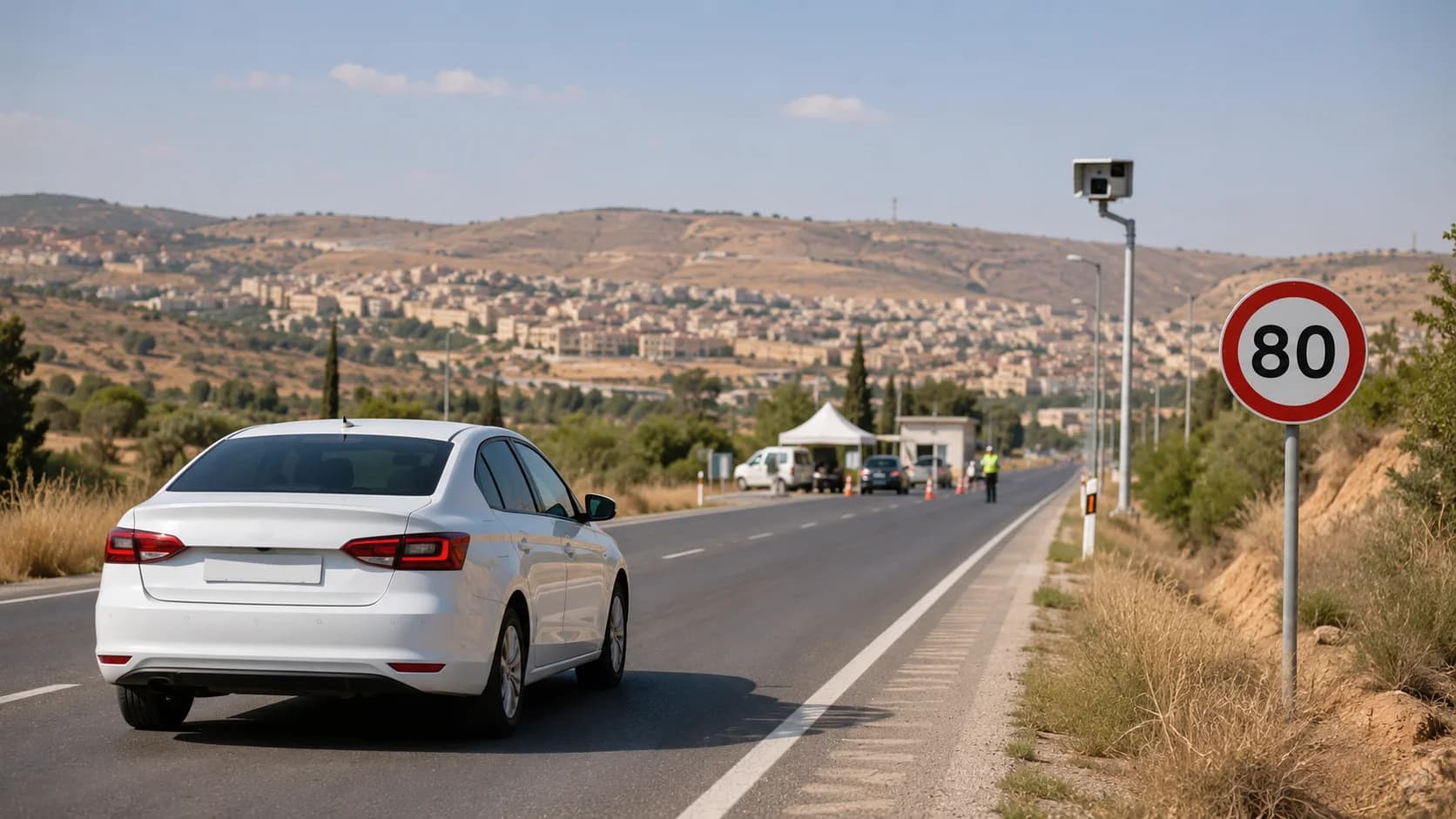
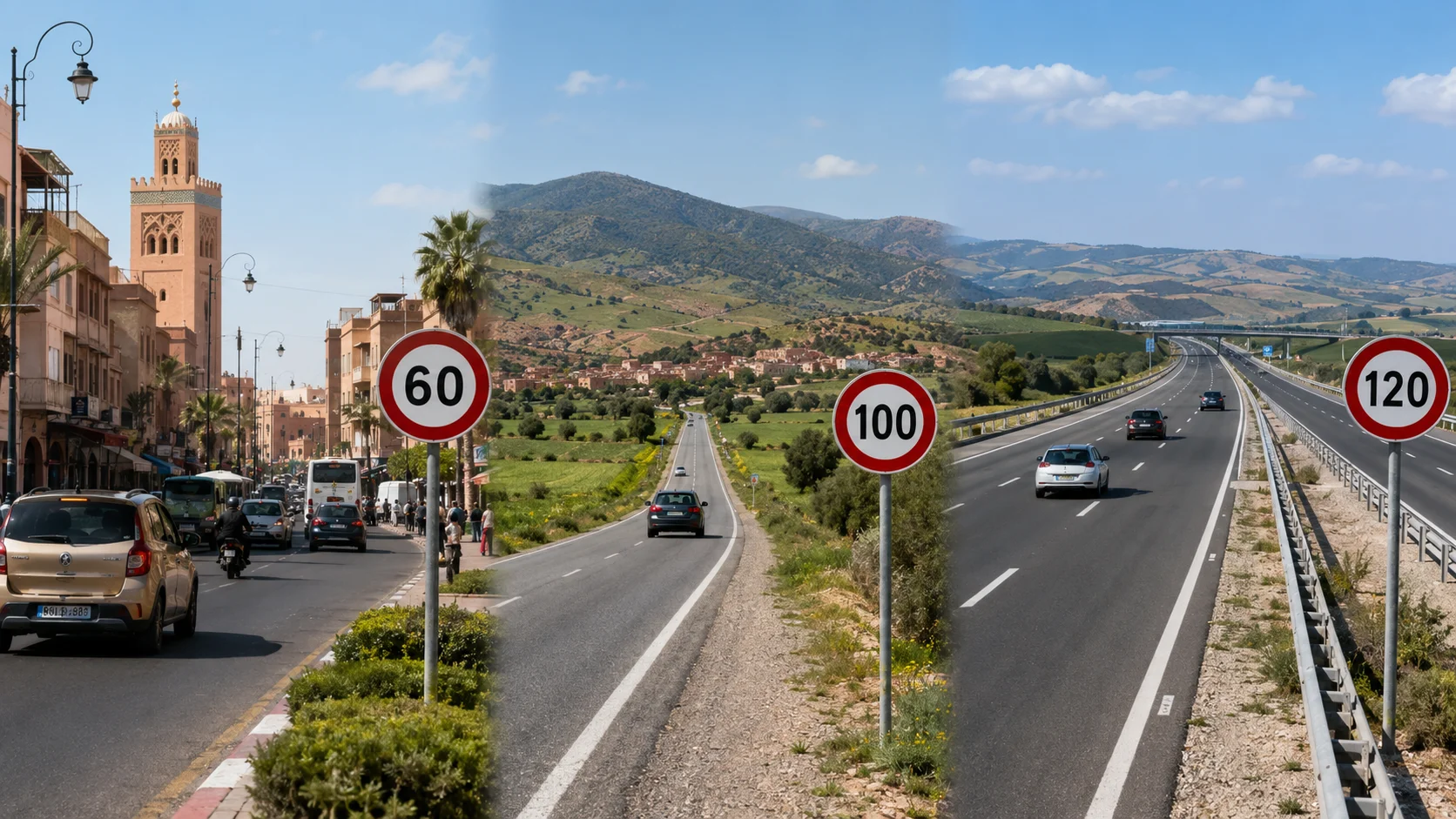
The main speed limits in Morocco are usually 60 km/h in towns, 100 km/h on roads outside towns and 120 km/h on motorways, but posted signs always come first. Morocco uses fixed speed cameras, mobile radar and frequent police or gendarmerie checkpoints, especially on roads between cities. For drivers leaving Fes, the biggest fine risk is not the motorway. It is the sudden 60 km/h or 40 km/h zone near villages, roundabouts, schools and town entrances.
Morocco speed limits by road type
If you are renting a car in Fes for the first time, speed is the rule you need to understand before anything else. Roads around Fes can feel open and easy, especially when you drive toward Meknes, Ifrane, Azrou, Volubilis or the Middle Atlas, but speed limits in Morocco are enforced seriously.
As a general guide, Morocco speed limits are commonly listed as 60 km/h in built-up areas, 100 km/h outside built-up areas and 120 km/h on motorways. Some major urban routes may show 80 km/h, and many town centers, school areas and village entrances can drop to 40 km/h or lower. The official motorway operator ADM also reminds drivers not to exceed 120 km/h on the motorway and not to drive below 80 km/h there.
Here is the simple way to remember it:
| Road type | Typical speed limit |
|---|---|
| Towns and built-up areas | 40 to 60 km/h |
| Major urban through-roads | Sometimes 80 km/h if signed |
| Roads outside towns | Usually up to 100 km/h |
| Motorways | Up to 120 km/h |
| Near schools, villages, works or roundabouts | Follow the posted lower sign |
The most important rule is this: the road sign beats the general rule. If your GPS says 100 km/h but the sign says 60 km/h, follow the sign. If the road looks empty but you are entering a village, reduce speed early.
For a relaxed road trip, a comfortable sedan rental Fes is usually enough for motorway and national-road routes from Fes, while a cheap car rental Fes can work well if you are mainly doing city, airport and short day trips.
How limits change suddenly near towns
The most common tourist mistake is not driving too fast on the motorway. It is staying at open-road speed when the road suddenly passes through a town or village.
Around Fes, this happens often. You can be on a calm road with a 100 km/h rhythm, then a small settlement appears, and the limit drops to 80, 60 or 40 km/h. The signs may come before the actual houses, so by the time you see shops, pedestrians or a school, you may already be inside the lower-speed zone.
Watch carefully for:
-
Town-name signs
-
Roundabouts
-
Petrol stations
-
Schools and pedestrian crossings
-
Speed bumps
-
Market areas
-
Parked taxis and shared vans
-
Police or gendarmerie presence at the entrance or exit of towns
On the Fes to Ifrane and Azrou direction, speeds can change because the road moves between open sections, villages and mountain approaches. On the Fes to Meknes or Volubilis side, you may feel the road is easy, but small towns and intersections still create sudden lower limits.
A good habit is to slow down before the sign, not after it. If you wait until the exact sign line, you may still be over the limit when a mobile radar is placed just after the change.
Fixed cameras vs mobile radar
Morocco uses both fixed cameras and mobile radar. For tourists, the difference matters because the fine process can feel different.
Fixed speed cameras are installed in set locations. They can record the vehicle automatically, and the fine may appear later. NARSA’s traffic-offences platform includes services for checking offences recorded by fixed radar, and NARSA explains that fixed-radar offences can be linked to fines and points depending on the category.
Mobile radar is different. This is usually a roadside control with an officer or gendarmerie team using a radar device. You may pass the radar point, then be stopped a short distance later. The officer may show the speed recorded, ask for your documents and issue a fine if you were over the limit.
Mobile radar is especially common:
-
Near town entrances and exits
-
On long straight national roads
-
Before or after roundabouts
-
Near bridges, petrol stations and intersections
-
On popular intercity routes
-
On roads where drivers often speed after leaving a slow zone
Do not assume that a road is safe to speed on because locals are driving quickly. Moroccan drivers often know where the controls usually are. Visitors do not.
What an on-the-spot fine looks like
A speeding fine in Morocco depends on how far over the limit you were and when the fine is paid. NARSA’s official payment table lists speeding under 20 km/h over the limit at 150 DH if paid within 24 hours, 200 DH within 15 days and 300 DH within 30 days. Speeding by more than 20 km/h and less than 30 km/h is listed at 300 DH, 350 DH or 500 DH depending on payment timing, with 2 points. Speeding by more than 30 km/h and less than 50 km/h is listed at 400 DH, 500 DH or 700 DH, with 4 points. More than 50 km/h over the limit is treated much more seriously, with higher penalties and possible licence suspension.
For a tourist in a rental car, the practical lesson is simple: even a “small” speed mistake can become annoying, especially if it happens more than once on the same trip.
If stopped after a mobile radar check, stay calm. The process usually includes:
-
The officer tells you the reason for the stop.
-
You may be shown the radar speed.
-
You provide your driving licence and vehicle papers.
-
The fine amount is explained.
-
You ask for the official receipt or proof of payment.
Do not argue aggressively and do not offer unofficial money. If there is a real fine, handle it officially. If you are unsure, politely ask for the written ticket or receipt.
For fixed-camera fines, payment can be made through official channels such as online payment, mobile banking, banking channels, ATMs, nearby service points or cash/check payment at Treasury offices, according to NARSA’s payment page.
How checkpoints work
Morocco police checkpoints are normal. They are not automatically a bad sign, and they are not only for tourists. You will see them on city exits, intercity roads, near roundabouts and close to regional borders.
Around Fes, checkpoints may appear when leaving the city toward Meknes, Ifrane, Sefrou or Taza. Sometimes they are full stops. Sometimes they are slow-down points where the officer waves you through.
The basic checkpoint rule is:
Slow down early, make eye contact, wait for the signal, then continue only when waved on.
Do not roll through quickly because the car in front of you did. Do not overtake a queue of cars near a checkpoint. Do not use your phone while approaching. Keep both hands visible and behave normally.
Many checkpoints are simple document or traffic-flow controls. If your car is properly rented, insured and documented, the stop can be very quick.
The headlight-flash warning explained
In Morocco, drivers sometimes flash headlights to warn oncoming cars about something ahead. It can mean a police checkpoint, a mobile radar, a road hazard, animals, a slow truck, a broken-down car or a dangerous bend.
For tourists, the best way to read a headlight flash is not “speed up after the danger.” Read it as “pay attention now.”
If someone flashes their headlights:
-
Check your speed immediately
-
Look for signs
-
Watch for pedestrians or animals
-
Prepare for a checkpoint or radar
-
Stay in your lane and avoid sudden braking
Do not rely on local warnings as your safety system. Sometimes nobody flashes. Sometimes the warning is too late. Sometimes it is about a hazard, not the police. Your best protection is steady legal driving.
What officers ask to see
At a checkpoint or after a radar stop, officers may ask for your driving documents and the vehicle documents. If you rent a car, keep everything in one easy-to-reach place, not buried under luggage.
You should normally have:
-
Your original driving licence
-
Passport or ID copy, depending on what you are comfortable carrying
-
Rental agreement
-
Vehicle registration papers provided with the car
-
Insurance documents provided with the car
-
International Driving Permit if your licence or travel advice requires it
UK travel advice says UK drivers should carry both the 1968 International Driving Permit and their UK driving licence in Morocco, and also says drivers should carry insurance, licence and registration documents. It also notes that hire car companies can have stricter age and experience requirements.
For other nationalities, the exact licence situation can vary by country, licence language and rental-company policy. If your licence is not in Latin characters, an International Driving Permit is a smart precaution.
When you book through car rental Fes, ask the team before pickup which documents will be inside the vehicle and which papers you should keep with you.
Staying calm and polite
Most checkpoint problems come from stress, confusion or impatience. The best approach is calm, simple and respectful.
When stopped:
-
Turn down music
-
Lower the window
-
Greet the officer politely
-
Hand documents when asked
-
Answer short questions clearly
-
Do not joke about police, fines or alcohol
-
Do not film the officer
-
Do not argue about Moroccan rules using rules from your country
French is useful, Arabic is useful, but simple English can still work in many tourist areas. If you do not understand, say calmly: “I’m sorry, I don’t understand. Can you explain, please?”
If you believe there is a misunderstanding, ask politely for clarification. If a fine is issued, ask for the receipt. Keep your rental company informed if the issue involves the vehicle, paperwork or a fine that may later be attached to the registration.
Avoiding fines on a Fes road trip
The best way to avoid driving fines in Morocco is not complicated. Drive like there is a radar after every speed-limit change.
For Fes road trips, be extra careful in these situations:
Leaving Fes city
Traffic, taxis, scooters, pedestrians and roundabouts can make driving feel messy. Stay slow until you are fully outside the city.
Road to Ifrane and Azrou
The route is beautiful but has changing speeds, bends, villages and weather changes in winter. Do not rush the climb.
Road to Meknes and Volubilis
Open sections can make you relax too much. Watch village signs and roundabouts.
Motorway sections
The motorway limit is generally 120 km/h, but that does not mean every section should be driven at 120. Weather, traffic, toll areas, roadworks and fatigue all matter. ADM’s safety message also reminds motorway users not to exceed 120 km/h.
Town entrances
This is the biggest radar-risk zone. If the sign drops to 60 km/h, get to 60 before the village, not inside it.
Downhill sections
Cars can gain speed without you noticing. Use engine braking and check the speedometer often.
A sedan is a good choice if you want stable road comfort without overspending. A budget car can also be fine for simple routes, but whichever car you choose, your speed habits matter more than the car category.
Pre-trip speed checklist
Before leaving Fes, take two minutes to prepare. It can save you money and stress later.
Check these points:
-
Your driving licence is with you
-
Passport or ID copy is easy to access
-
Rental agreement is inside the car
-
Insurance and vehicle papers are inside the car
-
You understand the basic speed limits
-
You know the route’s town and village sections
-
Your phone GPS is mounted safely, not held in your hand
-
You have some cash available for normal travel needs
-
You understand that posted signs override app speed limits
-
You know who to contact at the rental agency if a fine or document question happens
Also inspect the car before leaving. Make sure lights, tyres, mirrors, wipers and brakes feel normal. A clean, well-documented rental makes checkpoints easier because you can answer questions confidently.
Know the rules before you roll
Speed limits in Morocco are not difficult, but they require attention. The roads around Fes are ideal for day trips, airport pickups, family routes and scenic drives, as long as you respect the signs, slow down near towns and treat checkpoints as normal.
Know the rules before you roll. Rent a clearly documented, fully insured car from MarHire Car Fes and keep your road trip stress-free, legal and fine-free.
FAQs
What are the speed limits in Morocco?
The usual guide is 60 km/h in built-up areas, 100 km/h outside built-up areas and 120 km/h on motorways, but posted road signs always come first. Some areas may show 40 km/h, 80 km/h or other local limits.
How much are speeding fines in Morocco?
NARSA lists fines by how far over the limit you were and when you pay. Less than 20 km/h over the limit can be 150 DH if paid within 24 hours, while higher speeding bands can reach 300 DH, 400 DH, 500 DH or 700 DH, and very serious speeding over 50 km/h can lead to much heavier penalties.
Are there speed cameras in Morocco?
Yes. Morocco uses fixed cameras and mobile radar. Fixed-camera offences can be recorded automatically, while mobile radar may lead to a roadside stop.
Why do Moroccan drivers flash their headlights?
It can be a warning about radar, a checkpoint, animals, road danger, a slow vehicle or another hazard. Treat it as a reminder to slow down and pay attention, not as a guaranteed police warning.
Do police checkpoints fine tourists?
Checkpoints are routine and apply to everyone. Tourists can be fined if there is a real traffic offence, but many checkpoint stops are just quick document checks.
What documents do police ask for at checkpoints?
They may ask for your driving licence, passport or ID, rental agreement, vehicle registration and insurance papers. UK guidance also says UK drivers should carry the 1968 IDP with their UK licence in Morocco.
Do you pay Moroccan traffic fines in cash?
Some roadside situations may involve immediate payment, but fixed-radar fines can also be paid through official channels such as online payment, banking channels, ATMs, nearby service points or Treasury offices. Always ask for an official receipt or proof of payment.
How strictly are speed limits enforced in Morocco?
They are enforced seriously, especially near towns, roundabouts, national roads and common radar points. The safest habit is to slow down before every posted lower limit.
What is the speed limit in Moroccan towns?
Many towns are 60 km/h, but some areas are 40 km/h or lower, especially near schools, markets, speed bumps and busy centers. Always follow the posted sign.
Can a rental company charge you for a traffic fine?
Yes, if a fine arrives after your rental and is linked to the vehicle registration, the rental company may contact you or charge the amount according to the rental agreement. Ask your provider how fines are handled before pickup.