
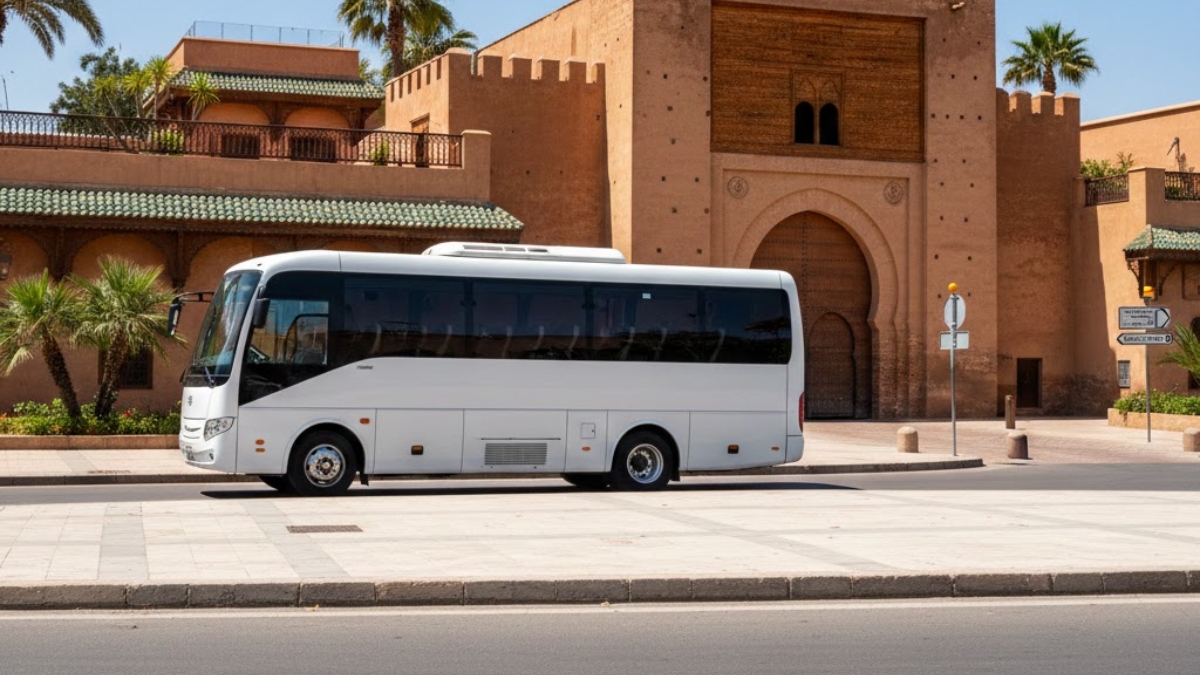
Fes is one of Morocco’s best group destinations: a world-famous medina, major religious heritage, universities, and easy links to Meknes, Volubilis, Ifrane, and the Middle Atlas. But group travel only feels “easy” when your transport is organized. The difference between a smooth arrival and a stressful one is usually simple: the right vehicle size, the right pickup spot, and a clear plan for timing, luggage, and payments.
This guide explains how group transfers in Fes work for tour groups, pilgrims, and student groups including vehicle choices, pickup points (airport, station, hotels), route planning, and WhatsApp coordination so your group moves like one unit.
Table of contents
Who this guide is for
Group transfer types in Fes
Best vehicles for each group size
Pickups: airport, train station, hotels, medina edges
Luggage and seating planning (the #1 group mistake)
Timing and seasonality: when to book early
How pricing is usually calculated
WhatsApp templates that prevent confusion
Itinerary ideas for tours, pilgrims, and students
FAQs
Who this guide is for
This guide is designed for:
Tour groups (guided city tours, day trips, multi-city loops)
Pilgrims and religious visitors (zawiya visits, heritage routes, group prayer schedules)
Student groups (study tours, exchange trips, campus visits, volunteer programs)
Families traveling together (multiple households, mixed ages, lots of bags)
If your group has fixed schedules (check-in windows, prayer times, museum slots, lecture start times), transfers should be treated like logistics, not “we’ll figure it out on arrival.”
Group transfer types in Fes
Most group transfers fall into three practical formats:
1) Point-to-point transfers
One direct trip: Fes Airport → hotel, hotel → train station, or Fes → Chefchaouen (etc.).
Best for: arrivals, departures, day trips with clear timing.
2) Half-day or full-day “disposal”
A vehicle and driver stay with your group for a set block of time.
Best for: packed days (medina + viewpoints + lunch + second activity) where stop timing may shift.
3) Multi-day circuit support
Transport across multiple days and cities.
Best for: student study circuits or pilgrim routes that include several towns.
Best vehicles for each group size
The “right vehicle” is about seats + luggage + comfort, not just headcount.
Small groups (4–7 passengers)
7-seater / large MPV or a spacious van
Good for: families, small student delegations, VIP guests with luggage.
Medium groups (8–17 passengers)
Minibus category
Good for: tour groups, pilgrim groups moving together, class groups with a leader.
Larger groups (18–30+ passengers)
Coach / large bus
Good for: big student groups, large pilgrim groups, conference delegations.
Pro tip: If everyone has a suitcase, you often need either:
a vehicle with dedicated luggage space, or
an extra luggage vehicle, or
a split plan (two vans instead of one bus) to keep it comfortable and safe.
Pickups in Fes: airport, train station, hotels, and medina edges
Fes Saïss Airport (FEZ)
Airport pickups are easiest when you share:
flight number
landing time
how many checked bags
a single group meeting point (“arrivals exit, everyone waits together”)
For official airport reference and basic passenger/airport info, you can check the airport authority’s page here: https://www.onda.ma/en/aeroports/fes-saiss
Fes train station
Stations are great for groups if you plan the “first five minutes”:
Who collects tickets/bags?
Where does the group stand while the leader confirms the vehicle?
Who counts heads before leaving?
Tip: Choose one meeting spot outside the station and keep the group stationary while the leader coordinates pickup.
Hotels in Ville Nouvelle (new city)
These are usually the simplest pickups because vehicles can stop briefly and load luggage without tight streets.
Medina and riads (old city)
Most vehicles can’t reach many riad doors. The best practice is:
agree on a medina-edge meeting point (a clear gate or accessible square)
do luggage handling with a plan (porters if needed)
keep the group together to avoid delays and lost guests
If your group itinerary includes heritage visits in the old city, it helps to understand why the medina is so unique and complex: Fes el-Bali is recognized as a UNESCO World Heritage site, which is one reason access and movement can be different than modern neighborhoods. https://whc.unesco.org/en/list/170/
Luggage and seating planning (the #1 group mistake)
The most common mistake is booking “enough seats” but not enough space.
Use this simple rule:
Daypacks only: you can plan close to full seating
Suitcases: reduce “usable seats” or add luggage capacity
Examples:
17 people with 17 suitcases often needs luggage space planning (or split vehicles).
Students with backpacks are easier to fit than pilgrims with large cases and supplies.
Also think about:
strollers or mobility aids
instrument cases / sports gear
water and boxed meals for long day trips
Timing and seasonality: when to book early
Book earlier when:
you arrive during school holidays
you land late (after-hours coordination)
you need multiple stops (airport → hotel → dinner → activity)
you require specific features (extra luggage, child seats, multilingual driver, invoice)
A smart baseline:
Simple airport → hotel for a group: book at least 1–2 weeks ahead
Minibus/coach in peak periods: book earlier to secure the right size and luggage layout
How pricing is usually calculated
Group transfer pricing is typically based on:
vehicle category (van/minibus/coach)
distance + expected driving time
number of stops (each stop adds time)
pickup hour (late night / early morning can cost more)
luggage complexity (extra vehicle or roof storage planning)
waiting time (if your group needs a long buffer)
Tip for student/pilgrim organizers: Ask for pricing in two formats:
point-to-point per trip
half-day/full-day disposal
You’ll often find that a busy multi-stop day is cheaper and smoother as a disposal booking than multiple separate rides.
WhatsApp templates that prevent confusion
Template 1: Group arrival (airport or station)
Hello, we are a group of [X] arriving to Fes at [time]. Flight/train: [number].
Pickup point: [arrivals exit / station main gate].
Please confirm vehicle type, plate info, and send a location pin.
Template 2: Headcount + luggage confirmation
Final count: [X passengers], luggage: [X suitcases + X backpacks].
Please confirm enough luggage space (or if we need a second vehicle).
Template 3: Multi-stop day plan
Today route: Hotel → Medina meeting point → Lunch → [second stop] → Hotel.
Start time: [time]. Please confirm total duration and waiting policy.
Itinerary ideas: tours, pilgrims, and students
Tour groups
Half-day medina + viewpoints
Day trip: Meknes + Volubilis style circuit
Middle Atlas nature day (if your schedule allows)
Pilgrims
Early departures to match prayer or visit times
Medinas and heritage zones with a clear regrouping point
Shorter walking segments with accessible drop-offs
Student groups
Tight scheduling with “buffer windows”
One leader per sub-group for headcounts
Clear rules: no one leaves the vehicle area without notifying a leader
FAQs
What’s the best pickup strategy for groups staying in the medina?
Choose a medina-edge meeting point that vehicles can reach, keep the group together, and plan luggage handling (porters if needed).
Should we book one big coach or two vans?
If luggage is heavy or the medina is a key part of your plan, two vans can be more flexible than one large coach. For big groups, a coach is great—just plan luggage space.
How early should a student group arrive for an airport pickup?
Be ready to meet 15–30 minutes after landing depending on baggage. Keep everyone at one meeting point while the leader coordinates.
Do we need a full-day booking for a city tour?
If you have multiple stops and timing may shift, a half-day or full-day disposal often reduces stress and can be better value than separate rides.
 Same prices and offers