
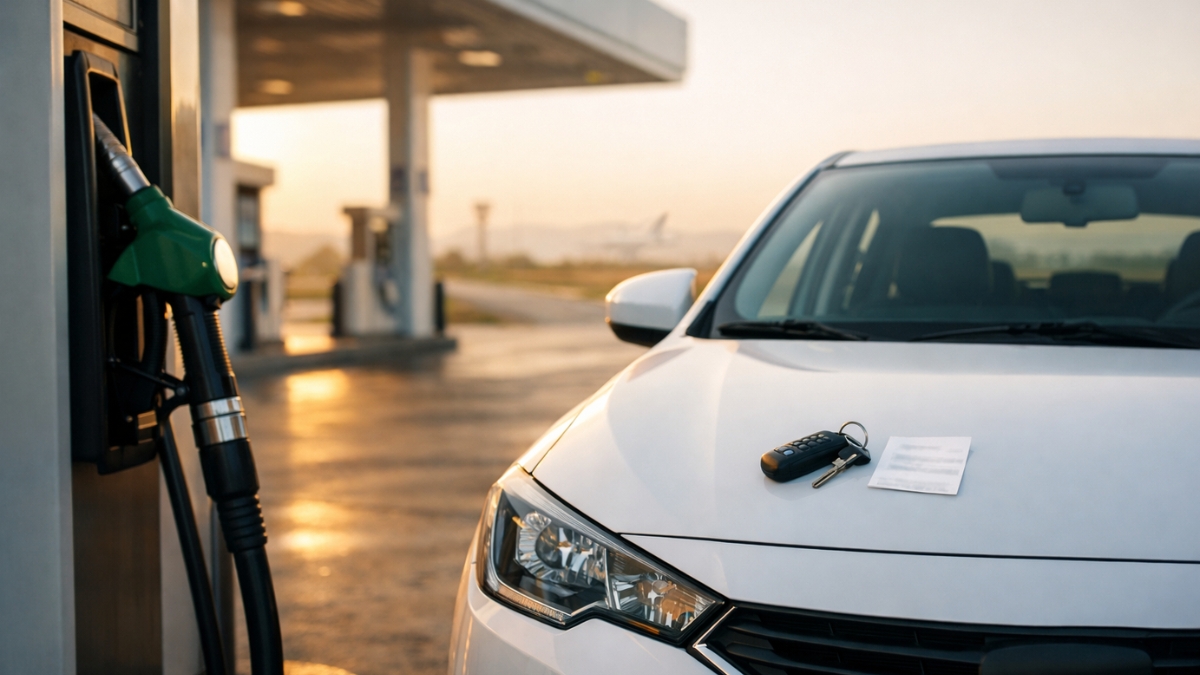
Full-to-full sounds simple: you receive the car with a full tank and you return it full. In practice, most “fuel stress” in Fes happens for two reasons: you refuel too early (then lose bars in traffic) or you refuel too late (and end up hunting for an open station near the airport when you’re already on a deadline).
This guide shows you how to handle full-to-full in Fes like a local: when to top up, where to refuel close to FEZ Airport, the easiest station strategies for city returns, and the small details that protect you from surprise fuel charges.
Table of contents
What “full-to-full” really means consideration-wise
The best refuel timing rule for Fes
Nearest fuel options near FEZ Airport
Best stations for city returns (new town vs medina edges)
Receipts, photos, and “last bar” realities
Diesel vs petrol: don’t make the expensive mistake
Night returns and early flights: what to do
Quick checklist before you hand back the keys
1. What “full-to-full” really means consideration-wise
Most rental companies judge “full” based on the fuel gauge bars, not how much you personally put in. That’s why two drivers can refuel the same amount and still get different results.
A smart full-to-full plan focuses on:
Gauge certainty (ending on the top bar/needle)
Location (refueling close enough that you don’t burn noticeable fuel after)
Proof (receipt + quick photo of the gauge)
It’s not about squeezing the last dirham, it’s about avoiding a “not quite full” claim.
2. The best refuel timing rule for Fes
Use this simple rule:
Refuel within the last 10–20 minutes of driving before return.
That usually works because:
Fes traffic can be stop-and-go near major junctions.
Small detours add up quickly.
Some cars drop a bar earlier than you expect once you start climbing/descending or crawling in traffic.
If you refuel 45 minutes before returning, you’re giving the gauge time to drop, especially with AC on, luggage loaded, and city congestion.
3. Nearest fuel options near FEZ Airport
FEZ (Fès–Saïs) is outside the city, and the “easy move” is to refuel on the main approach road that connects the airport to Fes. You’ll typically find multiple stations along the airport corridor rather than directly inside the terminal area.
The practical airport strategy (works almost every time)
Drive toward the airport first, don’t refuel deep in town.
Refuel on the airport approach road (close to your return point).
Keep the receipt and take a quick gauge photo.
A reliable way to identify nearby stations fast
If you want brand-locator accuracy (open hours, exact address, navigation), use one of these official station finders:
Shell station locator for Fes (use it to spot the closest open option on your route):
Shell station finder in FesTotalEnergies station locator in Morocco (helpful for checking the nearest station when you’re already near the airport corridor):
TotalEnergies station locator
A known reference point many drivers use
Some travelers prefer refueling at a clearly listed station on a major road in/near Fes before finishing the final airport approach. For example, Shell lists “STATION AUTOROUTE FES” with an address on Route de Sefrou, which can be useful depending on where you’re coming from.
Tip: If your return point is the airport, prioritize airport-corridor stations over “one last station in the city.” City stations are fine, until traffic eats your buffer.
4. Best stations for city returns (new town vs medina edges)
City returns in Fes usually fall into two patterns:
Ville Nouvelle / main boulevards (easier driving, wider lanes, straightforward station access)
Medina-edge areas (tight streets, one-way sections, more congestion)
If you’re returning in the Ville Nouvelle (new town)
Aim for stations on main boulevards or arterial roads with:
Easy entry/exit
Space to maneuver
Less risk of getting stuck behind double-parked cars
Best timing: refuel, then head straight to your return point without extra errands.
If you’re returning near the medina
Avoid leaving fuel to the last minute here. Instead:
Refuel before you commit to tight medina-edge traffic.
Choose a station with a simple in-and-out route (no complicated U-turns).
Rule of thumb: If your hotel is near the medina, do your refuel on a main road outside the tightest zone, then go park/collect bags, then drive out toward the return.
5. Receipts, photos, and “last bar” realities
Even honest drivers get flagged when the gauge is sitting just under full. Protect yourself with a 30-second routine:
Keep the receipt (date/time/location visible)
Photo of the fuel gauge immediately after refueling
Photo of the pump display (optional but helpful)
Also know this: some cars don’t show “full” until you drive a minute and the float stabilizes. After fueling, wait a few seconds, start the engine, and confirm the gauge before leaving.
If you’re still not at the top bar, do a small top-up. It’s cheaper than a fuel service fee.
6. Diesel vs petrol: don’t make the expensive mistake
In Morocco, many rentals are diesel. The pump labels are usually clear, but when you’re rushed, mistakes happen.
Before you refuel:
Check the fuel cap label and your rental paperwork
Say it out loud: “Diesel” or “Essence” before you grab the nozzle
If unsure, ask the attendant (simple and fast)
A wrong-fuel error is a trip-ender. Take five seconds and be 100% sure.
7. Night returns and early flights: what to do
Early flights and late returns are where full-to-full becomes tricky, stations can be open, but not the one you expected.
Use this plan:
Identify two candidate stations on your approach route (a primary and backup).
Refuel slightly earlier than usual if you’re worried about availability,but still keep it close enough that the gauge won’t drop.
If you arrive at a station and it’s crowded or partially closed, don’t panic, go directly to your backup option. That’s why you pick two
8. Quick checklist before you hand back the keys
Refuel within the last 10–20 minutes of driving
Confirm the gauge shows full (top bar / needle)
Keep the receipt (don’t crumple it into a pocket)
Take a quick gauge photo
Avoid extra detours after refueling
If the gauge looks “almost full,” do a small top-up
 Same prices and offers