
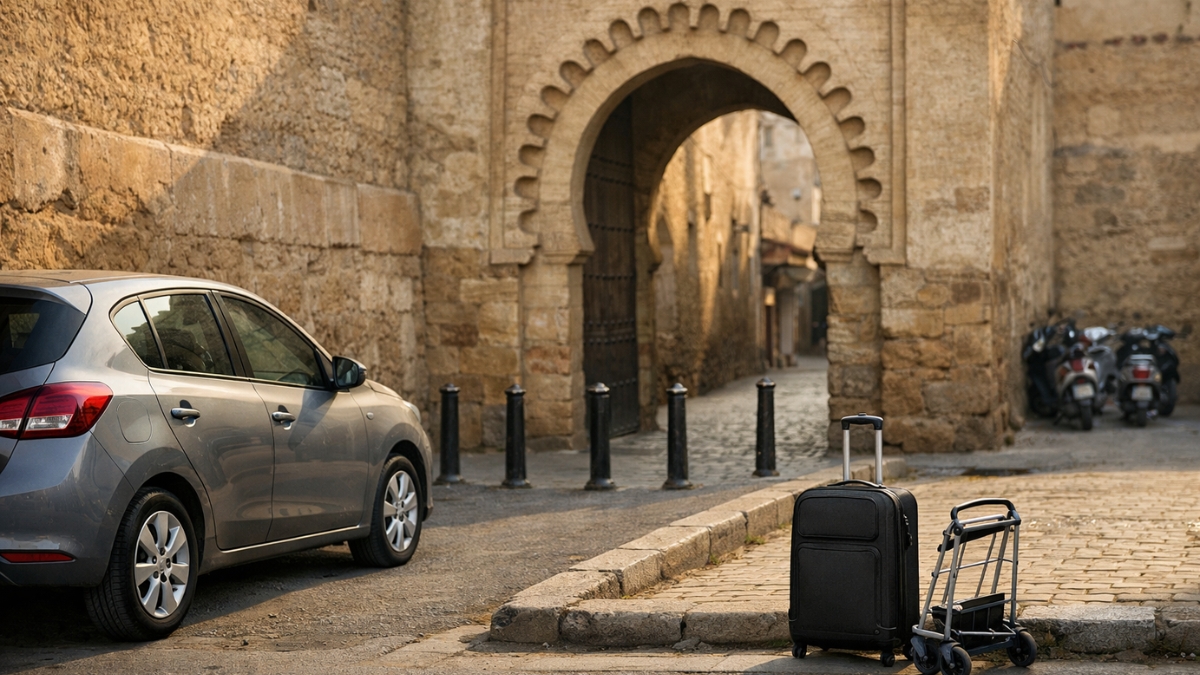
Fes is one of those cities where your navigation app can be technically “right” and still lead you into a headache. That’s because the historic core, is a living medina built for footsteps, handcarts, and pack animals, not modern vehicles. If you’re arriving by car (rental or private), the best plan is simple: drive to the right edge, stop where cars are meant to stop, and finish on foot (or with luggage help arranged by your accommodation).
For background on why the old city is protected and historically significant, you can read the Medina of Fez listing on UNESCO World Heritage Centre and a quick overview of the city on Encyclopaedia Britannica.
Table of contents
What “medina access” really means in Fes
Which cars are allowed and which are not
Where authorities stop vehicles (the practical choke points)
Best drop-off strategy for riads and hotels
Where to park without stress
Common mistakes that trigger fines, towing, or getting stuck
FAQ
1. What “medina access” really means in Fes
In Fes, “the medina” isn’t a single street you can drive through, it’s an entire maze of narrow lanes and gated entries. Most visitors assume they can drive “close enough” to the door of a riad. In reality, the last part is almost always a walk, even if your accommodation is technically “near a gate.”
So think of access in two layers:
Outer ring (vehicle zone): roads and squares outside the walls, plus a few approach streets near gates.
Inner medina (mostly pedestrian zone): the core where normal cars simply don’t belong.
Your goal is not to “enter the medina.” Your goal is to reach the correct gate-side area, stop smoothly, and switch to walking.
2. Which cars are allowed and which are not
Not allowed (for visitors in normal circumstances)
Standard private cars trying to drive deep into Fes el-Bali
Motorbikes/scooters attempting to weave inside narrow lanes
Vehicles following map shortcuts through alleys or covered passages
Sometimes allowed (but not for casual visitor driving)
Emergency vehicles (obvious)
Authorized service access (limited and controlled)
Residents or commercial permit holders in specific circumstances and areas
Hotel/riad logistics that have pre-arranged access to a controlled point (rarely “to your door,” more like a managed access edge)
The key idea: if you don’t have a local reason and a local authorization, assume you cannot drive inside. Even if you see a car somewhere near an opening, that does not mean the route is open for you.
3. Where authorities stop vehicles (the practical choke points)
Most “stops” aren’t dramatic roadblocks, they’re predictable control points where streets narrow, barriers appear, or police and attendants direct cars away from the medina interior.
You’ll typically be stopped or redirected in these situations:
At major medina gates where the road transitions into pedestrian pathways
At barrier/bollard points designed to prevent cars from rolling into lanes
At narrow funnels where two-way passing becomes impossible and traffic would jam instantly
At areas marked for taxis, deliveries, or controlled entry (locals may pass; visitors are waved away)
What it looks like on the ground:
A widening area (small square or gate-front) where cars can pause
A visible “no entry” feel: posts, chains, bollards, or simply a lane that becomes too narrow
Police/authorities or attendants signaling to turn back, park, or continue around the wall
If you’re unsure, don’t push forward “to check.” The safest move is to pull aside early, ask a nearby attendant (or call your riad), and reposition.
4. Best drop-off strategy for riads and hotels
If your accommodation is inside the medina, your “arrival plan” should be:
Choose the correct gate-side approach (based on where your riad actually is)
Stop at a legal, safe pull-in point or a known parking area
Move luggage efficiently (either carry, use a small trolley, or arrange porter help)
Do this before you drive in:
Message your riad: “Which gate is best for arrival by car, and where should the driver stop?”
Ask for a WhatsApp pin or a short instruction like: “Park at X, walk 6 minutes.”
If you have heavy luggage, ask if they can arrange assistance from the gate.
Why this matters
Many first-time visitors waste 30–60 minutes doing circles because they target the wrong side of the walls. Picking the correct gate-area is the difference between a calm arrival and an exhausting one.
5. Where to park without stress
Parking is less about “closest” and more about safe, guarded, and easy to exit.
Look for:
Official lots near gate areas
Guarded parking (you’ll often see an attendant, still, don’t leave valuables visible)
Clear access to the road you’ll use to leave later
Smart habits:
Keep bags and electronics out of sight
Take a quick photo of where you parked (and the nearest landmark)
Save your parking location on your phone before you start walking
If your riad recommends a specific lot, follow that advice. Local recommendations are usually based on which side of the medina you’ll enter and which parking is easiest for luggage.
6. Common mistakes that trigger fines, towing, or getting stuck
These are the classic “visitor errors” in Fes medina access:
Trusting the app over reality: a map line doesn’t mean a drivable road
Following another car blindly: that car may be permitted or simply taking a risk you shouldn’t
Entering a narrowing lane “just to see”: once you commit, you may not have space to turn
Stopping in a choke point: blocking traffic near a gate gets attention fast
Leaving valuables visible: even in busy areas, it’s not worth the risk
Rule of thumb: if the street looks like it’s built for pedestrians, it probably is.
FAQ
1) Can I drive to my riad door inside the medina?
Usually no. Most riads require a walk from the nearest gate-side stopping point. Plan for rolling luggage or arranging help.
2) Are taxis allowed inside the medina?
Taxis typically operate around the edges and drop you near access points. Inside, it becomes walking (or porter assistance).
3) What if my navigation shows a road through the medina?
Don’t follow it. Use the gate-side approach your accommodation recommends and stop at a proper parking/drop-off area.
4) Where do authorities usually stop cars?
Near gate-front funnels, barrier points, and any place where vehicle streets transition into pedestrian lanes. If you see bollards or the lane collapses into an alley, stop and reroute.
5) Is there any exception for deliveries or residents?
Some local access exists under controlled conditions, but it’s not something visitors should assume they can use without explicit local instruction.
6) What’s the easiest way to arrive with luggage?
Pick the correct gate-side area, park in a known lot, and walk in with light bags, or arrange porter help through your riad if you have heavy suitcases.
 Same prices and offers