
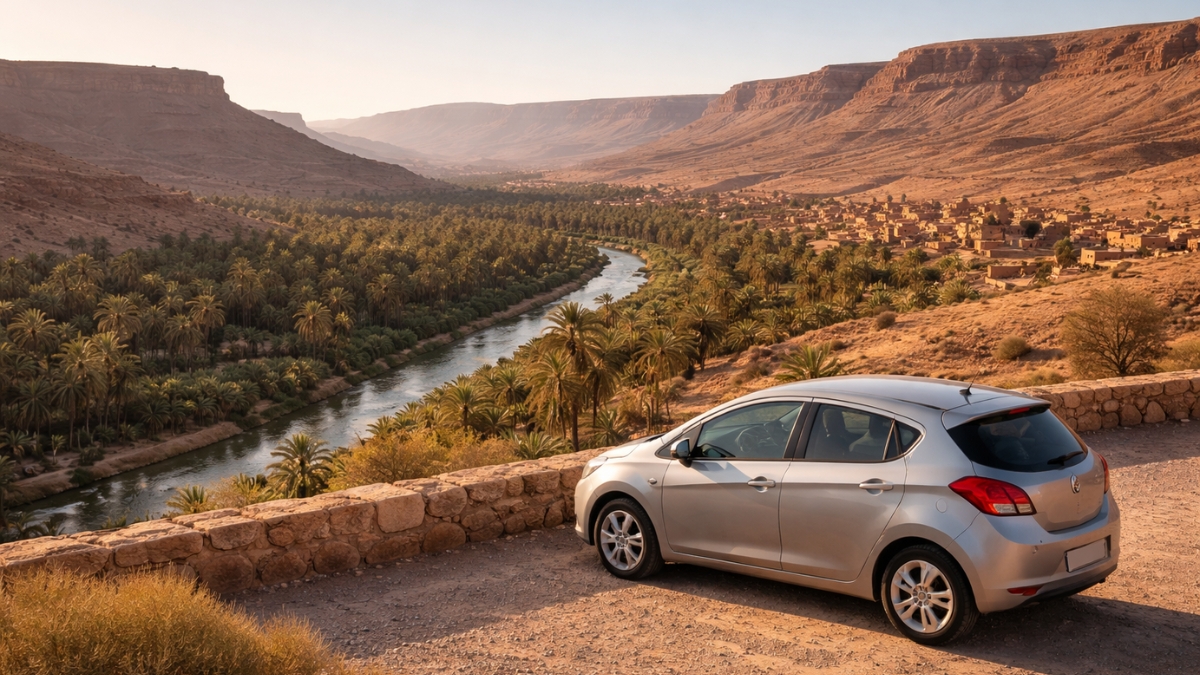
Driving from Fes to Merzouga is one of Morocco’s classic road trips: cedar forests and cool mountain air near the Middle Atlas, then wide valleys, palms, and finally the desert edge. The biggest decision isn’t “can I do it?”, it’s 2 days vs 3 days, because that choice determines how tired you’ll be, how many daylight hours you’ll actually enjoy, and whether the drive feels like an adventure or an endurance test.
Below is a practical planning guide: suggested route pacing, where fuel stops make sense, and which car type is actually smartest (spoiler: most people don’t need a 4×4 for the paved route).
Table of Contents
The route reality: distance, fatigue, and daylight
2-day plan (fast, efficient)
3-day plan (comfortable, scenic)
Fuel stops: where to refuel and why
Car selection: what you really need (2WD vs 4×4)
Road conditions and seasonal risks (snow, rain, sand)
“No surprise” checklist for pickup day
1) The route reality: distance, fatigue, and daylight
Most drivers underestimate two things:
Mountain driving fatigue (curves + elevation changes = slower average speed)
The “last stretch” effect (once you pass major towns, services thin out and night driving becomes less comfortable)
A common guideline is to treat Fes → Merzouga as an all-day drive if you do it in one push, so breaking it into 2 or 3 days is the smart move for safety and enjoyment. Many itinerary planners put it around a full day with stops on the direct inland route.
2) The 2-day route (fast, efficient)
Best for: confident drivers, limited vacation days, people who just want to “reach the dunes” without adding extra sightseeing days.
Day 1: Fes → Midelt (or nearby)
Why stop here: It breaks the drive before the longest “push” and keeps you in a practical town for fuel, food, and a decent sleep.
Typical flow (no need to rush):
Fes → Ifrane/Azrou area (cooler climate, cedar forests)
Continue toward Midelt
Early night, because Day 2 is longer
Driving style tip: Keep your pace relaxed through mountain sections. The goal is steady progress, not speed.
Day 2: Midelt → Merzouga (via Errachidia / Erfoud / Rissani)
This is the day where landscapes change dramatically:
Midelt → Ziz Valley viewpoints
Errachidia → Erfoud → Rissani
Final approach to Merzouga
Why 2-day works: you arrive before dark (if you leave Midelt in the morning) and you’re not arriving exhausted.
3) The 3-day route (comfortable, scenic)
Best for: families, couples who want stops, anyone who hates long driving days, winter driving, or first-time Morocco road trippers.
Day 1: Fes → Ifrane/Azrou → Midelt (shorter day)
You still end in Midelt, but you don’t push hard. This makes the trip feel calm from the start.
Day 2: Midelt → Errachidia / Erfoud (or nearby)
This is the “golden middle day”:
You get scenery + daylight for photos
You stop earlier, so you’re not doing a marathon
You’re positioned well for a relaxed desert arrival next day
Day 3: Erfoud/Rissani → Merzouga (easy arrival day)
Short final drive means:
You can arrive at a pleasant time
You’re not stressed about the last kilometers
You have energy to enjoy sunset plans rather than just “recover”
Why 3-day is worth it: The desert is better when you arrive with energy.
4) Fuel stops: where to refuel and why
Fuel availability is generally fine on the main paved corridor, but your best strategy is to refuel in major towns so you’re never “hoping” the next station is open.
Smart fuel plan (simple and reliable)
Top up around Midelt (end of Day 1 or morning Day 2)
Refuel again in Errachidia or Erfoud/Rissani before the final approach
Don’t arrive in Merzouga near-empty (you may do short drives or detours)
If you want a practical way to check stations along your exact line without guessing, use a station locator before you depart and pin 2–3 options in each major town. Shell’s Morocco station finder is one example that lets you search by town/area:
https://find.shell.com/ma/fuel/locations
Extra tip: Keep a small cash backup even if you normally pay by card, because remote pumps can be slower with terminals.
5) Car selection: what you really need (2WD vs 4×4)
Do you need a 4×4?
For the main paved route to Merzouga, most travelers do not need a 4×4. A standard car is usually sufficient for the road itself, while 4×4 is mainly for off-road tracks or rough detours.
The best “smart” car choice
Pick based on comfort + stability, not ego:
Best all-round:
A compact sedan / hatchback with good AC and decent ground clearance
Manual is fine; automatic is easier if you dislike mountain gear changes
Best for comfort (recommended for long days):
A slightly larger sedan (more stable, less fatigue)
Best if you’re going off paved roads (only if you truly will):
A real 4×4 but only if you plan desert tracks, rough piste routes, or post-rain conditions
What to avoid
Very small city cars if you’re sensitive to road noise and long hours
Underpowered cars if you’re fully loaded (4 adults + luggage) on mountain stretches
6) Road conditions and seasonal risks
Winter: snow and closures can happen
The Middle Atlas region can get snow in winter, and road disruptions around Midelt/Ifrane-area corridors are possible during strong weather events.
Before you depart (especially Dec–Feb), check official weather alerts so you don’t drive into avoidable conditions. Morocco’s official vigilance map is here:
https://vigilance.marocmeteo.ma/?q=fr/meteo/vigimet/generale
Rain: washouts and slower mountain driving
Heavy rain increases the risk of rockfall, standing water, and visibility issues. If rain is forecast, choose the 3-day plan if you can, fatigue plus bad conditions is the worst combo.
Desert edge: sand and night driving
Even near Merzouga, the main approach is paved, but:
wind can push sand onto the road in spots
night driving feels harder because services are sparse
Aim to arrive before dusk.
7) “No surprise” checklist for pickup day
Use this quick checklist before leaving Fes:
Tires look healthy (no obvious cracks, proper pressure)
Spare tire / repair kit present
Washer fluid (bugs/dust are real on long drives)
Phone mount + charger
Save offline pins for: Midelt, Errachidia/Erfoud, Rissani, Merzouga
Fuel rule: don’t pass a major town below half tank
Start early (daylight makes everything easier)
 Same prices and offers