
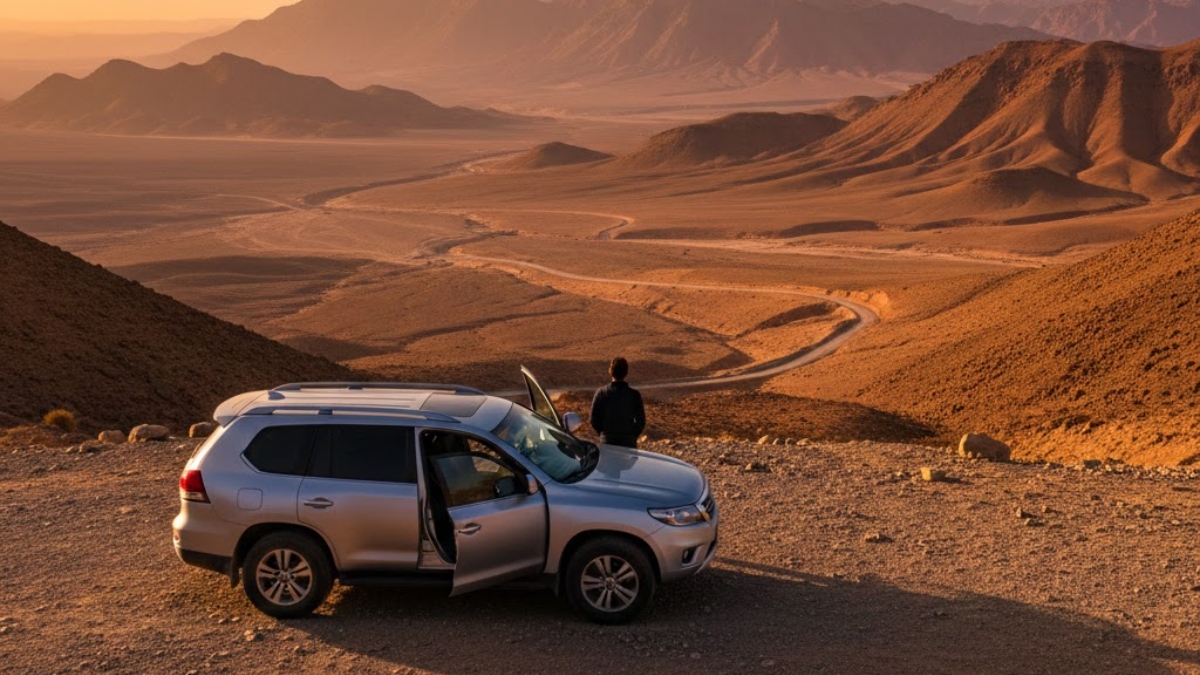
Many travelers dream of landing in Fes, driving to the Sahara at Merzouga, then finishing in Marrakech without having to come back the same way. The good news: yes, it’s possible as a one-way rental with a desert loop, but it needs to be set up correctly.
With MarHire, the idea is simple:
Pick up in Fes → Drive to Merzouga (Erg Chebbi dunes) → Drop off in Marrakech
…with the right car category, insurance, and one-way conditions agreed in advance.
This guide explains how the route works in reality, what MarHire typically checks before confirming it, and how to plan your timing safely for 2025.
Table of Contents
1) Short answer: yes, but only as a planned one-way desert route
2) Real distances Fes → Merzouga → Marrakech (not a quick spin)
3) How MarHire usually structures a Fes–Merzouga–Marrakech itinerary
4) Car choice, insurance & desert-use rules
5) One-way fees, deposits & what affects the price
6) When MarHire may say “no” or propose a different plan
FAQ
1) Short answer: yes, but only as a planned one-way desert route
From MarHire’s point of view, Fes → Merzouga → Marrakech is a big itinerary, not just a weekend road trip:
You cross Middle Atlas and high plateaus from Fes to Merzouga.
You drive desert and valley roads between Merzouga, Erfoud, Todra/Dadès area and Ouarzazate.
You finish with the High Atlas crossing (Tizi n’Tichka region) down into Marrakech.
So MarHire treats it as:
A one-way rental (Fes pick-up, Marrakech drop-off).
A desert routing (more kilometres, more wear, more logistics).
A file that needs good timing (enough days) and a sensible driver profile.
If your plan is reasonable, for example 4–7 days with at least one night in the desert and one in the valleys, it’s the kind of trip we do support, as long as the right car and insurance are chosen.
2) Real distances Fes → Merzouga → Marrakech (not a quick spin)
Before talking conditions, you need to know what you’re actually signing up for.
Fes → Merzouga
Road distance: roughly 460–470 km via Ifrane, Azrou, Midelt, Errachidia and Erfoud.
Real driving time: usually 7–8 hours of pure driving, without long photo or lunch stops.
Many travelers describe it as “a whole day on the road”, mountain curves, plateaus, palm oases, then finally the Erg Chebbi dunes.
Merzouga → Marrakech
Distance is in the ~550–560 km range via Erfoud → Tinghir → Todra Gorge → Dadès valley → Ouarzazate → Tizi n’Tichka → Marrakech.
Non-stop, it’s 9–10 hours of driving – which is why most people split it over 2 days with a night around Dadès or Ouarzazate.
The desert itself – Erg Chebbi near Merzouga – is one of Morocco’s iconic dune fields, with long ridges of sand, palm groves and a proper Sahara atmosphere. The Moroccan National Tourist Office describes the Merzouga area as one of the great “gates of the Sahara,” with dunes, palm groves and the Dayet Srij lake when water is present. You can see this in more detail here:
Errachidia–Midelt–Merzouga region on the official Morocco tourism site
Bottom line: yes, it’s doable – but it’s a serious, multi-day drive, not an afternoon excursion.
3) How MarHire usually structures a Fes–Merzouga–Marrakech itinerary
Every booking is custom, but a typical MarHire-friendly plan looks like this:
Day 1 – Fes pick-up and drive toward the south
Morning: pick up your MarHire car in Fes (city or airport).
Route via Ifrane → Azrou → Midelt → Errachidia.
Option A: push all the way to Merzouga in one day (long, but common).
Option B: stop for a night around Midelt or Errachidia to break the drive.
Day 2 – Merzouga and desert time
Drive the final stretch (if you didn’t reach Merzouga the first day).
Park at your desert camp or hotel meeting point.
Take the classic camel or 4×4 excursion into the dunes, sunset/sunrise, etc.
The car remains at the edge of the desert, MarHire cars are for paved and good-quality tracks, not for deep sand dune driving.
Day 3 – Merzouga → Todra/Dadès valley
Drive back via Erfoud → Tinghir → Todra Gorge / Dadès.
Spend the night in the gorges or valley (ideal break point).
Day 4 – Dadès / Ouarzazate → Marrakech
Morning: cross to Ouarzazate/Skoura.
Afternoon: cross the High Atlas via the Tizi n’Tichka region and down into Marrakech.
Evening: drop the car at Marrakech (airport or city) as agreed.
If you have more days, you can slow this down with extra overnights. If you have fewer than 3–4 days, MarHire may recommend an alternative plan because it becomes too rushed and tiring to be safe.
4) Car choice, insurance & desert-use rules
For this kind of routing, MarHire usually looks at:
Car category
Compact or mid-size sedan / hatchback is OK for most travellers if you stay on paved roads and good gravel.
SUV / crossover is more comfortable for long distances and rougher sections, especially if you’re 3–4 people with luggage.
Insurance
Because of distance and conditions, MarHire will strongly recommend:
Good coverage with a clear damage excess.
Clear rules on windscreen/tyre coverage (desert roads can be hard on both).
A higher deposit or stronger cover for SUVs and premium models.
For independent drivers, a solid, non-promotional overview of driving conditions, police checks, fuel and road rules is very helpful. One example is this long-form guide on driving in Morocco and road trip tips, it’s a traveler resource, not a tour operator, and it highlights practical issues like speed checks, winter passes and road etiquette.
Desert-use rules
MarHire’s desert rules are usually along these lines:
No dune driving with a standard rental (sand = very high risk of damage and getting stuck).
Stick to roads and marked tracks appropriate for your car category.
Let the professional local 4×4 or camp team handle deep sand.
The idea is to keep the desert fun (camel, 4×4 tours, camp) and your rental car safe on the edges.
5) One-way fees, deposits & what affects the price
A Fes pick-up and Marrakech drop-off through the desert means MarHire has to:
move cars between northern and southern fleets,
plan staff and logistics to reposition vehicles,
allow for more kilometres and wear than a simple city rental.
So your quote will usually include:
Base rental price (days × car category).
A one-way fee for Fes → Marrakech.
A deposit level that reflects car type + itinerary risk (desert region, long distances).
What tends to push the price up:
very short rentals (e.g. trying to do everything in 2 days),
very high season dates,
asking for luxury SUVs or premium sedans.
What can help keep it reasonable:
booking enough days so the driving is spread out,
choosing a category that really matches your group (not oversizing for no reason),
confirming all main details (drivers, route, drop-off point) early, so MarHire can plan fleet movements.
6) When MarHire may say “no” or propose a different plan
Even if the idea is technically possible, MarHire may say “this routing isn’t recommended” in some cases, for example:
You want to do Fes → Merzouga → Marrakech in only 2 days, with no real rest.
You’re travelling in mid-winter and insist on crossing high sections during possible snow or ice without flexibility.
Your driver profile (very new licence, previous accident file, etc.) doesn’t match the risk of this route.
The dates coincide with a very high-traffic period when fleet availability is tight.
In those situations, MarHire might propose:
a partial self-drive (e.g. Fes → Merzouga and back, then train or flight to Marrakech), or
a mix of car + driver on one section and self-drive on the rest.
The goal is always the same: keep you safe, protect the car, and make sure your schedule is realistic for 2025 roads and traffic.
FAQ
Can I really drop the car in Marrakech after starting in Fes?
Yes, as a one-way rental, if it’s requested and confirmed in your contract. There will normally be a one-way fee and specific conditions attached.
Is it safe to drive Fes → Merzouga in one day?
Many people do, but it’s a long, full-day drive (around 7–8 hours of pure driving). Starting early, sharing driving between two licensed drivers and avoiding night driving makes it much safer.
Do I need a 4×4 to reach Merzouga?
No, the main roads to Merzouga are paved and used by normal cars every day. A 4×4 is only necessary for deep desert tracks, which are usually handled by local guides and camp vehicles, not standard rentals.
Can I keep the car at the desert camp?
Normally you park at a hotel/meeting point near the dunes. The camp arranges a camel or 4×4 transfer into the sand. Your MarHire car stays safely on solid ground until you come back.
What if weather blocks the High Atlas on the return to Marrakech?
In winter, passes can sometimes be closed for snow for short periods. If this happens, you adjust timing and routing with MarHire support, another reason to avoid last-minute, ultra-tight schedules.
Is this itinerary OK for a family with kids?
Yes, as long as you plan enough days, add frequent stops, and choose a comfortable car with good air-conditioning. A 4–6 day Fes–Merzouga–Marrakech plan is usually far more family-friendly than trying to compress everything into 2–3 days.
 Same prices and offers